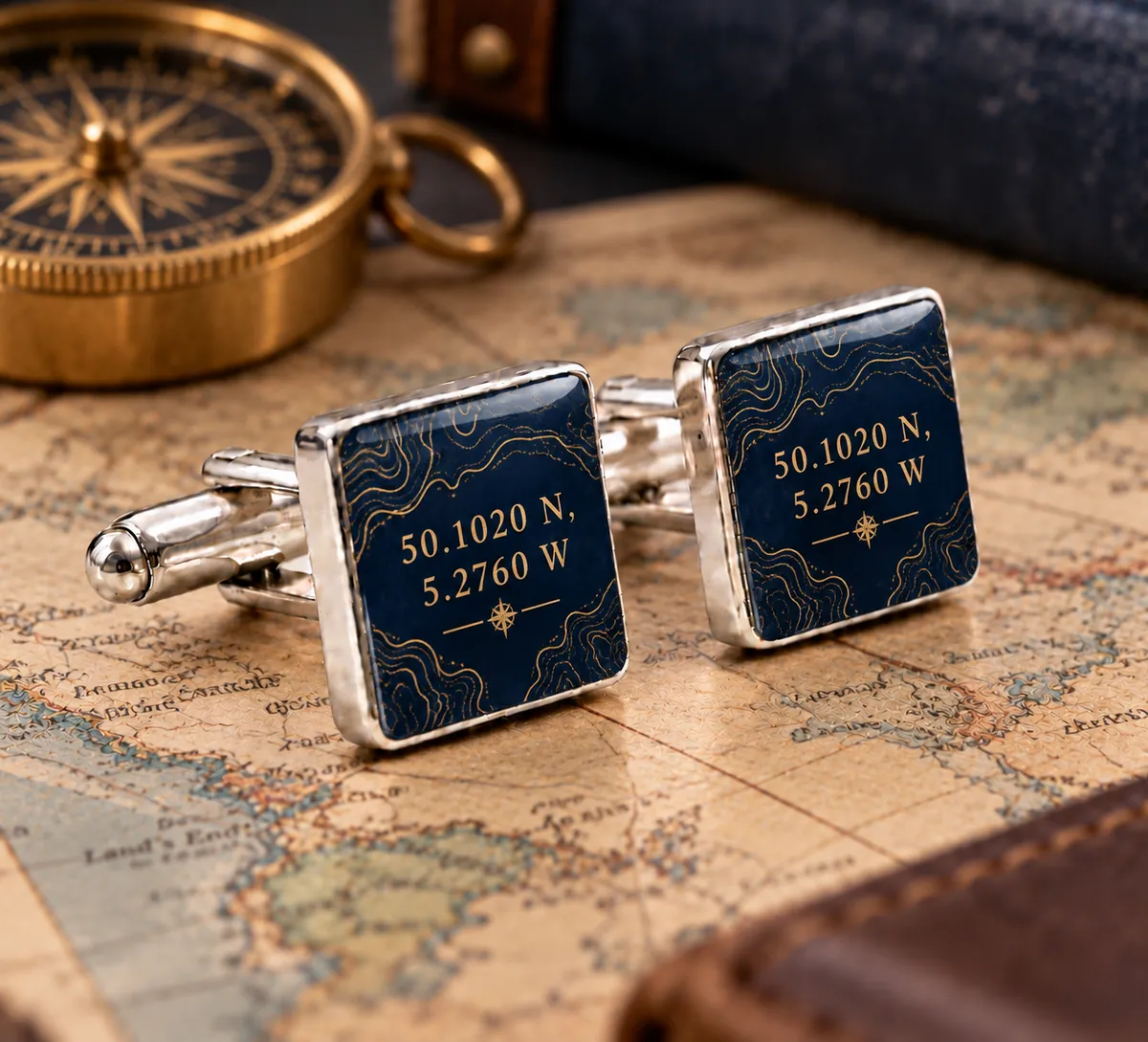
Personalised coordinates cufflinks have a lovely air of secrecy. To most people they look like a neat line of numbers. To him, they're a precise place on the planet that changed his life. They suit men who like maps, sailing, walking, travel or a good puzzle, and anyone who would rather wear a meaning than a message.
Places worth pinning down
Almost any location can be a coordinate. A few ideas to get you thinking:
- Where you met – the pub, the festival field, the office, the lecture theatre.
- Where you married – the church, the registry office, the beach, the hotel.
- Where he proposed – the viewpoint or bench where the question was asked.
- The family home – the house he grew up in, or the first home you bought together.
- A child's birthplace – the hospital or, for the dramatic ones, the back of the car.
- A place of belonging – the rugby ground, the boatyard, the family farm, a favourite surf break.
For a wedding party, coordinates cufflinks are a neat alternative to a date: every usher wears the location of the ceremony, and only the people who were there will recognise it. For a man who has moved abroad, the coordinates of his home town can be a small anchor on the other side of the world.
Coordinates also carry weight for families remembering someone. The spot where ashes were scattered, a favourite fishing mark or a well-loved bench can be marked quietly, without any words at all.
Finding the exact numbers
On most map apps and websites you can press and hold, or right-click, on a location to reveal its coordinates. They usually appear as two decimal numbers, for example 50.3350, -4.6380. The first is latitude and the second is longitude.
A couple of things to know for UK locations:
- Latitude will be positive, because Britain is north of the equator.
- Longitude will be negative for anywhere west of the Greenwich meridian, which covers most of the country, including all of Cornwall. When you write it with a compass letter, the minus sign becomes W.
Zoom right in before you drop your pin. At the level of detail most people use, moving a few metres changes the last digit, so place the pin on the exact doorway or bench if that matters to you.
Decimal or degrees and minutes?
There are two common ways of writing the same location:
Decimal degrees: 50.3350° N, 4.6380° W. Clean and modern, and easy to read.
Degrees, minutes and seconds: 50°20'06" N, 4°38'17" W. More traditional, with the look of a nautical chart or an old explorer's log.
Both are correct, so choose whichever suits his taste. Four decimal places is plenty for identifying a specific building, and it keeps the numbers short enough to sit comfortably on a square.
Designing the layout
The most natural arrangement is latitude on the top line and longitude beneath it. From there you can add:
- A small compass rose or a map pin icon above the numbers.
- A thin border, like a postage frame.
- A place name or a date in smaller type below.
- A very faint outline of the coastline behind the text.
If you're giving a set of coordinates cufflinks to a group, keep the layout identical and change only the numbers, so the pairs look like a family. Use a clear typeface with distinct numerals. Monospaced and typewriter-style fonts suit coordinates well, as every digit takes up the same width and the lines align neatly. Keep the degree, minute and second symbols big enough to see.
How to order
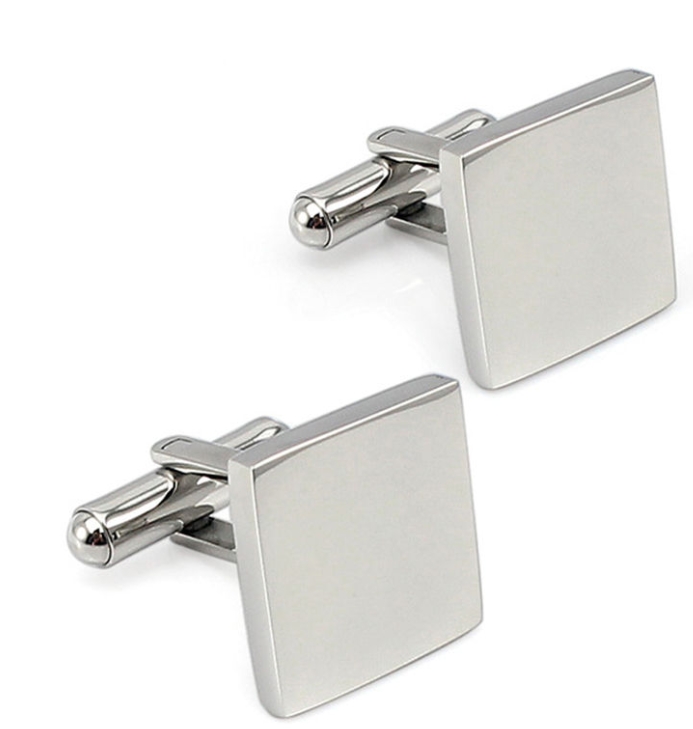
Create your design in any app and save it as an image. Upload it, and the live preview shows it on both cufflinks; drag and zoom so both lines of numbers are centred and easy to read. Once the numbers look right, it goes in the basket and through our secure checkout.
Single pairs are £40 with shipping included. For five pairs or more, each pair is £15 plus £5 shipping per order, and different designs can be mixed in one basket, so each sibling could carry the coordinates of their own childhood home. Every pair is made in our Cornwall workshop and gift boxed.